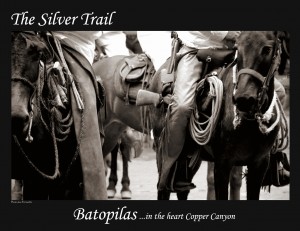
Following the Silver Trail

2009 October Journal of the Silver Trail

Our own Amigo, Marco Ivan Fernandez, writer, photographer and guide extraordinaire, was invited to go along this year as part of the reenactment of the moving of the Batopilas silver along the Silver Trail to Chihuahua. Silver was mule-trained from Alexander Shepherd's 'Hacienda San Miguel' in Batopilas over an 8-day run across the Sierra Madre, along the plains and desert and finally into the city of Chihuahua.

This group, consisting of 22 people including doctors, photographers and professional mule skinners was conceived to rescue the historical value of this long and rugged ride that was a way of life for the silver mining industry of Batopilas in the late 19th century. This ride is also a tribute to the mule skinner, a profession and a way of life that is on the verge of extinction. This generation of mule skinners may very well be the last of its kind as children leave the farms and back country to seek out more opportunities in the cities and more sophisticated road and highway infrastructures are now reaching areas where only mules could go in years past.

To put yourself in the mood for our story, have a look at this video called the Mule skinner Blues. The same types of wagons and mule trains you'll see in this video were used to transport the silver in our story.

We will chronicle here the 13-day ride that these true adventurers covered as they retraced the old Silver Trail through the canyons, including many alternative trails.

These mule trains would travel from one 'Way Station' to the next daily with some days taking as long as 10 hours to complete, depending on the terrain. These stations were set up about every 40 kms in order to give the riders food, water and a bed. There was a family who lived at and maintained the stations and the local Raramuri Indians were on hand as well to sell corn and hay for the mules and maintain the trail.

Day 0 / October 4th:

Our trip was set to begin today, October 4th of 2009, but was canceled because the Munerachi Arroyo, a tributary of Batopilas River, could not be crossed at La Junta. The original Silver Trail follows the aqueduct and comes to La Junta and then crosses the Munerachi Arroyo and continues along the Northface to the Way Station of Portrero, our intended stop for the night. However, because the Munerachi Arroyo was too high to cross, we decided to wait another day and try out luck tomorrow.

Day 1 / October 5th:

This first day was pure excitement for all of us. To contemplate the possibilities that this trail had to offer was a unique experience. Each one of us had a vision in our own minds of riders past and how they must have felt as they set out to move $60-$80,000 dollars in silver bars across the wild Sierra. The original mule-train would need 50 to 150 mules, depending on that months load, each mule to carry 2 silver bars that weighed 72 lbs a piece. The mystery that shrouds this labyrinth of trails, that stretches over 330 miles from one point to the other, brings with it a mixture of feelings from excitement to joy to fear.

Because I have always been a passionate historian, always interested in learning more about the mystery of the past, trapped in pages of books, this was another chance for me to actually 'be' there, riding this route in the old traditional way. It was a sensation that I could not duplicate by just reading about it. It was the long hours of riding ahead of me that would give me the first hand perspective of what it was like to live in those days. This was an immersion! A crossing of time that would take me to a different dimension of reality. The contemplation of a different era from the back of a horse and a true communion with myself.

Many Municipalities, led by the Batopilas Municipality, along with Carlos Granados from Carachic, the organizer of our expedition and the great grandson of Nerio Ortega, the original leader of the mule-train employed by Alexander Shepherd, had endeavored to make our journey match the old ways as much as possible. In so doing, we were to wear the traditional material of Manta, a cotton that is processed without chemicals, just as the Arrieros and poor of the era would wear. Our hats were made in the old traditional way from a variety of the palm tree. Our shoes were Guaraches, Raramuri sandles, or cowboy boots. Saddled up and with high expectations, we set off on our journey, ready to face the day and what it would bring with it.

Leaving Batopilas

Leaving Batopilas

The trip began from the rugged silver mining town of Batopilas this morning at 10:30am. We had gathered at the ruins of Hacienda San Miguel with our mules saddled and ready to go at 8am, but because the arroyo was still too high to cross, we decided to wait a bit and see if it would subside. We stood in small groups discussing how our trip would be affected if the crossing could not be done. Would we wait another day? Would we use the alternate trail? As we considered our choices, and how each decision would affect our ride, several Arrieros rode the 3 miles to the crossing to see if the water level was going down. The riders returned with bad news, the arroyo was still too high to cross. We would have to use the alternate route. By 10am we had decided to go with Plan B. We were all a bit disappointed that on our very first day we weren't going to be able to use the first original section of the trail but we also knew that the Arrieros in the old days would have had to use this alternate route when water levels were high. Due to our delay this morning, we would only be able to make it as far as Santa Rita in Munerachi Canyon instead of our intended goal of Portrero Station in Batopilas Canyon.

Crossing the Arroyo

The alternate trail follows the Munerachi Arroyo up on the left side towards Cerro Colorado. We crossed the Arroyo where it was cross-able about 8 miles up stream from Batopilas. From there, we started our ascent towards the Indian hamlet of Santa Rita, situated on an outcropping of Munerachi Canyon. We rode 6 hours today, arriving in Santa Rita around 4:30pm at an altitude of 4,716 feet. Those 6 hours in the saddle were more than enough for us today and we set about to make camp. Some of us, the photographers and doctors, slept in tents. The Arrieros and wranglers though slept out in the open air, using their saddles for pillows and their saddle blankets for bedding, hats dipped low over their faces. The Arrieros acquired a goat from one of the Raramuri Indians in the community of Santa Rita, and set about to roast it. We all felt very tired and although we only rode 6 hours, the expectations of running into further delays en route and being behind schedule left us all more tired than we should have been. We spent the rest of the evening getting to know each other, drinking coffee and singing Corridos, Revolutionary folk songs, later to retire and dream the dreams of adventurers.

Roasting a Goat

Roasting a Goat

Day 2 / October 6th:

Looking back on this day, it had started out with a sense of excitement and hope. Today we would make it to our first real Way Station, Teborachi, as we rejoined the original Silver Trail. However, events would soon turn on us and our day would end in tragedy. The drama of daily life in the canyons and the hardships that were faced in those days, heretofore vivid in our minds eye, but unexperienced, would confront us all on a personal level this day.

We awoke to a beautiful sunny day. This gave us much relief as we were worried the weather would turn ugly again as it had been raining for an entire week prior to our departure. There was great apprehension that our trip, could possibly, be wet and miserable if the rains were to continue. The day, however, turned out to be sunny and warm and very inviting. We sat down to a sparse breakfast of hot coffee with pinole. Pinole is a ground corn that is used by the Raramuri, and especially useful for canyon crossings as it is light and easy to carry. It is also easy to prepare with water or eaten by itself and gives one a great burst of energy. We went about our morning duties, saddling mules, breaking camp, and preparing for our departure.

We left camp at around 8am and headed up the trail towards Mesa Quimova that sits on the ridge, hovering between Batopilas and Munerachi Canyons at an elevation of over 6,000 feet. About 1.5 hours into our ride, the trail became more treacherous as dirt and small pebbles turned to flat rock or laja. We had a few horses with us and because they are not as sure footed as the mules, tire faster, and are more skittish, they are not greatly depended on for this type of passage. Mario, a wrangler, had brought his horse along but was very fortunately riding a mule today in order to let the horse rest. He had the horse tied up to his mule's saddle and was pulling him along in order to help him find his footing on the rock. An Arriero who was riding behind him had advised him to untie it and let it go loose due to the unstable terrain we were about to pass through. Mario too felt uncomfortable with the horse tied to his saddle and he heeded the warning, untying the horse to let it follow on its own behind his mule. As we began to cross this section of the trail that was quite steep, only minutes after Mario untied his horse, the horse hit a patch of loose flat rock and lost her footing. The unfortunate mare could not recover from the skid and fell backwards into the canyon.

I was shocked. We all knew that this passage was dangerous but in this instant the very real possibility of death in the canyons struck me in the chest. As one of the photographers on the trip, I had just been taking photos of the trail from above, and with camera in hand, witnessed the fatal fall of the mare. My mind was so overcome by this shocking moment that my fingers would not work and the photo of the final end to this horse's life would not be taken. The photo below, however, shows a section of the trail just minutes before the accident. Mario is the lead rider there and you can see his horse following behind him. He had only just let it loose.

Where the first horse fell

Slippery Slope where first horse fell

Mario rushed to the canyon edge while I tried to calm down Olivia, Mario's wife, another wrangler. Because our group had gotten separated due to this unfortunate occurrence, the only ones of us present at this time was Mario, Olivia, an Arriero and myself. The 3 of them walked back down the switch back trail and finally found the horse stuck up in the branches of an oak tree a bit off the trail. I had chased after one of the mules that had escaped in the confusion and tied it to a nearby tree. I then returned to steady another horse, tie him up, and to await the others. They joined me about half an hour later, splattered with blood and with grim news. The horse had broken her back in the fall but was still alive as it struggled up in the tree. They had tried to free her to no avail and Olivia was pained greatly to have to leave the horse to die slowly in the tree as we had no weapons among us to put her out of her misery and end her life quickly.

This photo was taken just after the horse died and shows the sadness on the faces of the Arrieros. Arrieros sad over the death of the first horse

Arrieros in Mourning over loss of horse

We continued our journey and finally caught up with the rest of our group about half an hour later, on trail ahead, where they had been waiting for us. We relayed the story to them and they too were saddened but we needed to press on. We continued along this ridge, past the Mesa of Coyachique with its spectacular views of Batopilas Canyon on the right. We rode to the Mesa of El Pandito and stopped for lunch there around 2pm. We had a solemn lunch of beef jerky, canned sardines and crackers with a pinole and water mixture to wash it down. The views here were really amazing. We were perched on this ridge or mesa at the junction of two canyons; Batopilas Canyon on the right and Huimayvo Canyon in front of us. We left Batopilas Canyon behind now and followed the ridge along Huimayvo Canyon, veering left on the northern wall. This was a particularly scary time for me as I was still shaken up from the fall of the mare and to make matters worse, we were following a very narrow trail with the plunging canyon on the right. I couldn't take many photos during this period because of my very real fear that any slight movements to reposition myself would unbalance the mule and pitch us into the canyon below. The trail here was so narrow that it was known by the mule-skinners as 'El Infiernito', the little hell in English. I remember being terrified as I would look down to check the width of the trail on my right side, where the canyon lay, but could see nothing but the horses belly. No sign of the trail at all beneath me. My fears of falling and visions of a painful death were soon to become a reality as before long we were to lose yet another horse, this time in the canyon of Huimayvo.

We had been traveling about an hour and a half from our lunch break at El Pandito when we encountered a steep, rocky pass on the trail. One of the doctors among us was riding his horse ahead of me and was trying to negotiate this steep section when his horse lost his fore footing and fell back on his hind legs in an effort to steady himself. The horse's back legs found no purchase on the rocky ground and he tumbled backwards over top of the rider. The doctor was very fortunate in that he managed to let go of the animal, throwing himself out of the saddle, towards the canyon wall and away from the edge. He smashed heavily into the wall, bruising his back seriously, and both he and the horse began to tumble down the trail toward the edge of the canyon. The horse was falling ahead of the rider and caught himself by the saddle in between two sharp rocks, stopping his momentum. The doctor then rolled right into the horse and stopped as well. The doctor was put onto one of the spare mules we had and we rescued the horse and continued on. The horse looked okay on the outside but the internal damages were bad and he would die the next day in Samachique.

This photo was taken at El Pandito where we had lunch. You can see one of the Arrieros there with the Canyon of Batopilas in the background. El Pandito area

El Pandito Area

We rode on through oak and pine country, up in the high sierra, and began to feel more relaxed as the dangerous passes were behind us. Finally we came to Teboreachi around 5pm, at an altitude of 6,379 feet. It had been a very long day for us. We could only look to the future at this point with discomfort and fear if today's ride was any indication of how the rest of the trip would go. We were comforted a bit as the Arrieros told us that we had gone through the most difficult part of the trail. The rest of the ride was to be easier they said since we had passed this 'test'.

For my part, the ride so far had been a very grueling experience because I was not only just riding the mule cross country but taking photos as well and managing my camera and settings. Just carrying the equipment was difficult. Even the wranglers and Arrieros seemed to understand this. It was as if I was carrying a baby in the saddle in front of me. Trying to be in the right spot, capturing the moment, thinking ahead to position myself to get the next 'great shot'. It was exhausting when coupled with the dangerous passes, steep climbs and emotional stress of the day. My backside was sore already and my saddle had only one stirrup so I had to constantly hang onto the horn. Because there was nowhere to put my right foot, I was always off balance and my back and rear end were taking a pounding. My saddle was also too small for me so this combination of elements made for a very vexing 2 days. It had been a 9 hour ride today and looking back, we can only wonder how the Arrieros of the time would go from Batopilas to Teboreachi in only one day.

Teboreachi Way Station was ideally located next to a creek in a clearing between the mountainsides. The Arrieros had wrapped up the remainder of the goat from last night in cardboard and had carried it with us to eat tonight. Instead of roasting it today, we cooked it 'a las brasas', basically the goat was laid out on top of the super hot embers from of the fire and was left to cook slowly for about 2 hours. The Arrieros would come and flip it occasionally. We had planned to eat a snake as well and it had been skinned and put on the embers too but unfortunately one of the Arrieros mistook it for a piece of wood and buried it by mistake under the embers. Tonight would pass with each of us finding our own solace and reflecting on the events of the day.

In this photo: Teboreachi Way Station with the Batopilas Arrieros

Temoreachi Station with Arrieros

Day 3 / October 7th:

Breakfast was coffee and pinole again with a few flour tortillas. I was happy to realize that this simple meal would suffice me until lunch. We all carried a bit of beef jerky with us as we rode to snack on if needed, but on the whole, the pinole was very filling and provided sufficient energy that I never felt hunger pains. We left camp at 8am again this morning.

We crossed the Arroyo of Huicochi about 15 times this morning as we followed the creek upstream from Teboreachi towards our next Way Station, which would be La Laja. We were not to follow the traditional trail all the way to this station though as we were to meet up with the International Bike Race 'La Vuelta de Chihuahua', for promotional reasons, at the Batopilas/Guachochi junction. Because of this, we detoured towards Samachique a bit where we would ultimately decide to leave the injured horse from yesterday.

An Arriero resting

An Arriero Resting

The weather was cool and pleasant today as we passed through the upper sierra, the air heavy with the scent of pine that I found invigorating to my senses. We soon came to another small ravine with the Arroyo Huimayvo running at the bottom of it on our right side. The trail would take us up and down by about 30 to 40 feet above the Arroyo as we traversed the area. We had our next accident presently when I became separated from the group. I was riding 4th to last on the mule train with just the two doctors and one Arriero behind me. I soon found myself alone on the trail near the creek as the front part of the mule train was riding faster and had moved on ahead, while the back end of the had disappeared from my vision. I caught up with the front end eventually and we all waited for the back end to arrive. When they came into view about 20 minutes later, we could see there was an injured rider. Apparently the doctor who was riding behind me had been thrown from his mule. His mule had come to a dead stop on the trail and refused to budge as there was a snake on the trail ahead. The doctor, not being a horse-man, tried to bully the mule into moving on rather than reading its behavior and as a result was violently bucked off and tumbled about 30 feet down the ravine, bruising his ribs painfully. The other doctor was fortunately behind him and was able to minister to him quickly.

We pushed onto Samachique and stopped for lunch around noon. We bought ham, bread, tuna, sausages and some soft drinks from one of the village stores. This was the first time we had access to a telephone and store since we had set out. We had detoured here in order to meet up with the bike race being held as there was to be many journalists and photographers there who would be interested in our passage, alas, they had already passed and our detour was in vain. Not only had we missed part of the original trail, but we now had to actually ride down the highway in order to make it to La Laja. Needless to say, we were not amused. Riding on a the hard road only compounded our pains and jostled us about but it also ruined the essence of the ride.

We arrived at La Laja at 4:30pm, 8 hours in the saddle today with 3 of it on payment had left us feeling over-tired.


For more photos from the Silver Trail ride in 2009 and the latest one in 2010, please visit www.AdventureQuestPhotography.com

copyright amigos3.cz | edgedesign.cz 2007